m i l l i c e n t s w i n s o n
The Question of Guernica

"Why did Pablo Picasso paint such shit?" It’s an intriguing question, a question mumbled in solitude at one point or another by every reputable art historian, and many disreputable ones as well. The reputable art historian ten feet away from me at the Museo Reina Sofia in Madrid didn’t mumble it at all, but rather bellowed it, and his indignant query will forever complement my memory of seeing Guernica in person. The reputable art historian in question, an American fellow of 19 or 20 in a backwards baseball cap and t-shirt honoring a state university, walked straight out the other side of the room. He probably wanted to spend more time pondering the conceptual art on the 4th floor.
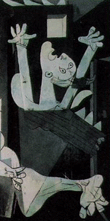 I found myself alone with Picasso’s horse, Picasso’s light bulb, and Picasso’s woman being turned into a Sno-Cone. Sno-Cone Woman balances the canvas by balancing, counteracts the general leftward thrust of events and reassures the viewer with her simple mission. She wants to get to the little window, and she won’t.
Current events can endow a work of art with retroactive significance. A sex scandal may spike Nathaniel Hawthorne’s book sales; a piquant martyr- dom recalls "John Brown’s Body." Lysistrata, along with any number of terrible songs, gains currency during ill-advised wars. I looked at Guernica, that timeless crystallization of Spanish suffering and comment on the untenable dehumanization inherent in modern progress, and realized that current events can also render a work of art completely unimportant. It had been a mistake to tell my husband about Diego, and even more of a mistake to tell my husband about Diego via e-mail, while traveling on our joint checking account. It didn’t help that I’d spent two hours with Diego earlier that day. Diego likes clear forms and vanishing-point perspective, but more importantly, Diego’s mind runs in a straight line, with pitiless rationality. I always liked that about Diego, and I couldn’t help but think of him as I loitered in front of Guernica. "Why did Pablo Picasso paint such shit?" I mused. I felt like a disreputable art historian indeed.
It took me about half an hour to realize that Guernica is set indoors. The floor tiles give it away, as does the table, and the line where wall meets roof, but the presence of the horse had confused me. Picasso makes an oblique reference to Pietro Longhi’s indoor rhinoceros. Granted, the rhinoceros seems to be in a stable of some sort instead of Picasso’s tavern, but the decadent fish-out-of-water quality remains the same. Longhi
 celebrates the flagrant wealth and worldwide muscle of 18th-century Venice, a proprietary and expansionist qual- ity distinctive to West- ern culture. Any self- respecting plutocrat who can afford a rhino will buy a rhino, unless of course they prefer a Bengal tiger, or a yacht named after a stripper. The men in Longhi’s painting have decided that there’s nothing like a rhinoceros and its attendant dung to impress the young masked ladies in back, whom they hope to take back to their gondolas, which are named after courtesans. This curious value system propelled Europe directly into World War I, a proprietary and expansionist war from which Picasso recused himself due to an aesthetic distaste for brown uniforms. Picasso, one of the great sex predators of 20th-century art, usually depicted himself as Harlequin, the colorfully dressed and drastically horny Commedia dell’Arte stock character. The aftermath of World War I led, by virtue of its endless capacity to inspire fascism, to the Spanish Civil War, during which somebody bombed a public house and inspired Picasso to paint such shit. Guernica documents the continued autoevisceration of Western culture, which has its root in the conflict between the proletariat’s will to economic self-determination and the bourgeois desire to keep animals indoors against all reason. The setting of Guernica blurs the line between bar and barn, the gathering place of the free masses and a perceived dominion over nature (and, by extension, man).

Diego Velazquez made a habit of docu- menting conceit among the dizzyingly well-to-do. His masterpiece, Las Meninas, features him- self witnessing a royal hanger-on stepping on a large and noble dog, which pretty much says it all. The Spanish royal court of the 17th century could afford pedigree dogs, elegantly attired dwarfs, and indentured painters of the highest genius. It could also afford a complete lack of self-awareness and that special lack of taste available only to persons of unlimited wealth. I commenced my affair with Diego because he saw people for what they were, and he told them even when they didn’t want to listen. Pope Innocent X shied away from Velazquez’ portrait, moaning that it was too true to life. People have painted more realistically than Velazquez, but Picasso would have gone back in time and told them that life isn’t the least bit realistic, and that what exists often has little to do with what is seen. I’m sure that the human version of Philip IV had a much bigger head than Diego gave him, but Diego painted a king, and the king of Spain at the time consisted of countless yards of fabric funneled through a collar. If
 my time at the Prado Museum is any indication, Diego’s career consisted of disembodied royalty, bombastic grotesqueries, some juvenile religious works, and a tenderly sympathetic portrait of a dog.
A major airline’s in-flight magazine com- missioned me to shoot photographs of Madrid’s nightlife for an article entitled, "Life, Music, and Pasión in the Hot Spots of Spain’s Main City." I only used up half a roll of film, as I planned most of my days around the Prado’s opening hours. My husband e-mailed to tell me that he finished rebuilding our deck, so I told him about my affair with Diego, whom I characterized falsely as handsome and very falsely as vivacious.
 My husband works at a hardware store in Aberdeen, Washington, and he never got the news about Western culture having lost its tenability in the first half of the 20th century. He drives a large Chevrolet adorned with radio-station bumper stickers. I have no idea where he got so many bumper stickers, but he doesn’t tell me about much aside from his periodic home- improvement triumphs. He hangs out in a bar called Lucky Sal’s, and the clientele at Lucky Sal’s would certainly introduce a horse to the premises if they could fit one through the door.
 My husband bears an uncanny resemblance to the bull in Guernica, the one that recently entered stage right through a blown-out wall. My husband mimics its vacant expression, its open mouth, and especially its horns. I married him during an ill-advised spate of class tourism, and now he wants me to bear the hardware scion of southwestern Washington, so I’ve become a travel photographer. My husband spends his annual two weeks in Wyoming, where he and his buddies co-own a lakeside trailer with an enormous cache of beer.
In Guernica, everyone who can move is running away. The Sno-Cone Woman doesn’t have any legs, so her only way out is up. Picasso also deprives of legs the woman on the far left, so she clutches her baby and cries, the whole bar about to collapse on her. The only other legless figure is the man with a broken sword—without his instrument of destruction, his masculine agency, he finds himself in the same position as the two women. One woman possesses legs, but she doesn’t have a chance in hell of escaping two-thirds of the way across the canvas. The horse and bull may have ventured into the bar with curiosity or even concern, but now they scramble to turn around and leave the humans to their own destruction. Picasso responds to the disaster of war with a disastrous painting, a painting that honest art historians can only describe as "such shit." Like Diego Velazquez, Picasso dispenses beauty only where warranted, and Guernica is essentially an update of Diego’s tiny-headed royal portrait, a "Where Are they Now?" report on cultural values after 300 years.

Picasso once started a more ex- plicit update of a Velazquez work. His version of the painter, which in both paintings isn’t a portrait of Velaz- quez but a context- ualization of the artist as observer, towers above all other figures on the canvas. His dog, on the other hand, re- mains blank—a vulgar dachshund of nothingness. I admit that Picasso left this work unfinished, and he may have had big plans for the dog, but first he had to conjure a monumental artist to preside over the rest of his work. In Diego’s work, the artist lurks in the shadows. Light and color center themselves on the princess in whose honor the painting exists, but Diego lends such an air of sordidness to the proceedings that no amount of light and color can actually do her honor. Velazquez focuses on the rich, the class traditionally called the lights of the world, and displays all their shortcomings. Picasso keeps the light where it is, but he removes the shadows, bulldozing the topography of human pursuit under the skewed eyes of the artist. I chose Diego, the humble man with a dissonant voice, and retreated where the young man in the baseball cap went before me.
MILLICENT SWINSON is a semi-professional photographer based in Aberdeen, Washington. She travels the world, writes about art, and burns the majority of her exposed film. Swinson enjoys long walks, loneliness, and maudlin accordion music. She started taking photographs in high school, and once shot a specialty knife advertisement that ran in several dozen periodicals. She plans to conquer the field of revisionist art history, complete her mammoth photo essay on cardboard Burger King crowns, and pursue a fulfilling extramarital affair.